Hi, I’m Deepro Choudhury.

I work on Bayesian experimental design for large language models: agents that gather information by asking the most informative question.

DPhil student in Machine Learning and Statistics, University of Oxford (StatML CDT), advised by Tom Rainforth and Mark van der Wilk

Research Scientist Intern, Apple MLR, since May 2026

First author of BED-LLM (ICLR 2026)

Research

Language models now act as agents that gather information over many turns, from people and from the world. How quickly they reach a useful answer depends on which question they ask next.

My main tool is sequential Bayesian experimental design. In BED-LLM (ICLR 2026, first author) we showed how to estimate the expected information gain of a candidate question from the model’s own predictive distribution, then ask the most informative one. On 20 Questions this raised success by 37.4 percentage points on average over direct prompting.arXiv v3, Section 1; Code

20 Questions one of 12 animals is hidden
tiger zebra giraffe mouse bat penguin eagle flamingo ladybird spider crocodile frog
belief3.58 bits left
  1. Is it a mammal?0.98
  2. Can it fly?0.92
  3. Is it bigger than you?0.92
  4. Is it black and white?0.65
  5. Is it green?0.65
  6. Does it have spots?0.65
  7. Is it pink?0.41

The best first question splits the 12 animals 5 to 7: EIG = H(5/12) = 0.98 bits.

Figure 1. BED-LLM (ICLR 2026) in miniature: ask the question whose answer you can least predict.

At Apple I am turning that inference-time algorithm into a reinforcement-learning post-training objective.

Before Oxford I worked on mechanistic interpretability and on formal mathematics. With Oliver Nash I wrote the first formalisation of root systems, in Lean; its definitions are now the foundation of mathlib4’s growing theory of root systems and Lie algebras.mathlib4 PR #8882; PR #8981

Publications

2026Featured

Featured ICLR 2026 Poster First author

BED-LLM: Intelligent Information Gathering with LLMs and Bayesian Experimental Design

Deepro Choudhury, Sinead Williamson, Adam Goliński, Ning Miao, Freddie Bickford Smith, Michael Kirchhof, Yizhe Zhang, Tom Rainforth

BED-LLM picks each question by maximising its expected information gain, estimated from the LLM’s own predictive distribution, and substantially improves how well LLMs gather information over many turns.

+37.4 points mean success over direct prompting (20 Questions) arXiv:2508.21184v3, Section 1
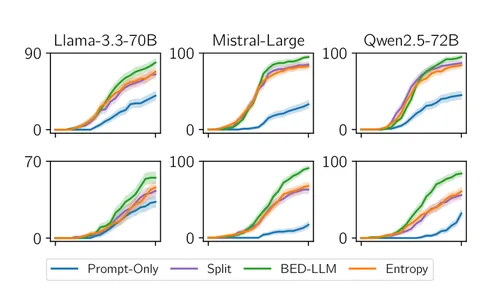
Success rate over 20 turns of 20 Questions on the Animals (top row) and Celebrities (bottom row) datasets for Llama-3.3-70B, Mistral-Large and Qwen2.5-72B: in every panel the BED-LLM curve (green) ends highest, well above prompt-only questioning (blue).
Success rate over 20 turns of 20 Questions; BED-LLM is the green curve. arXiv v3, Figure 2 (crop).
Abstract

We propose a general-purpose approach for improving the ability of large language models (LLMs) to intelligently and adaptively gather information from a user or other external source using the framework of sequential Bayesian experimental design (BED). This enables LLMs to act as effective multi-turn conversational agents and interactively interface with external environments. Our approach, which we call BED-LLM (Bayesian experimental design with large language models), is based on iteratively choosing questions or queries that maximize the expected information gain (EIG) with respect to a variable of interest given the responses gathered previously. We show how this EIG can be formulated (and then estimated) in a principled way using a probabilistic model derived from the LLM’s predictive distributions and provide detailed insights into key decisions in its construction and updating procedure. We find that BED-LLM achieves substantial gains in performance across a wide range of tests based on the 20 Questions game and using the LLM to actively infer user preferences, compared to purely prompting-based design generation and other adaptive design strategies.

BibTeX

Cite as Choudhury et al., “BED-LLM: Intelligent Information Gathering with LLMs and Bayesian Experimental Design”, ICLR 2026.

@inproceedings{choudhury2026bedllm,
  title={{BED}-{LLM}: Intelligent Information Gathering with {LLM}s and Bayesian Experimental Design},
  author={Choudhury, Deepro and Williamson, Sinead and Goli{\'n}ski, Adam and Miao, Ning and Bickford Smith, Freddie and Kirchhof, Michael and Zhang, Yizhe and Rainforth, Tom},
  booktitle={The Fourteenth International Conference on Learning Representations},
  year={2026},
  url={https://openreview.net/forum?id=qyylZMLYT8}
}
2025

ICLR 2025 XAI4Science Workshop Poster

Towards Mechanistic Interpretability of Graph Transformers via Attention Graphs

Batu El*, Deepro Choudhury*, Pietro Liò, Chaitanya K. Joshi * Equal contribution

Attention Graphs combine attention across a Graph Transformer’s layers and heads to show how information flows between nodes, revealing that models given all-to-all attention do not tend to follow the input graph.

Abstract

We introduce Attention Graphs, a new tool for mechanistic interpretability of Graph Neural Networks (GNNs) and Graph Transformers based on the mathematical equivalence between message passing in GNNs and the self-attention mechanism in Transformers. Attention Graphs aggregate attention matrices across Transformer layers and heads to describe how information flows among input nodes. Through experiments on homophilous and heterophilous node classification tasks, we analyze Attention Graphs from a network science perspective and find that: (1) When Graph Transformers are allowed to learn the optimal graph structure using all-to-all attention among input nodes, the Attention Graphs learned by the model do not tend to correlate with the input/original graph structure; and (2) For heterophilous graphs, different Graph Transformer variants can achieve similar performance while utilising distinct information flow patterns. Open source code: https://github.com/batu-el/understanding-inductive-biases-of-gnns

Presented at the workshop as “Understanding Information Flow in Graph Transformers via Attention Graphs”. Work began as a Geometric Deep Learning course project at the University of Cambridge.

BibTeX

Cite as El et al., “Towards Mechanistic Interpretability of Graph Transformers via Attention Graphs”, ICLR 2025 XAI4Science Workshop.

@article{el2025towards,
  title={Towards Mechanistic Interpretability of Graph Transformers via Attention Graphs},
  author={El, Batu and Choudhury, Deepro and Li{\`o}, Pietro and Joshi, Chaitanya K.},
  journal={arXiv preprint arXiv:2502.12352},
  year={2025}
}
2024

NeurIPS 2024 FITML Workshop Poster

Fitness Aware Human Motion Generation with Fine-Tuning

Kiril Bikov, Shiye Su, Deepro Choudhury, Zhilin Guo, Weihao Xia, Mehmet Salih Çeliktenyıldız, Chenliang Zhou, Param Hanji, Cengiz Oztireli

Fine-tunes a human-motion diffusion model on Functional Movement Screen scores so that it generates motion matched to a given fitness level.

Abstract

Diffusion models have recently gained considerable attention in 3D human motion generation due to their ability to handle complex human movements. However, existing models fail to incorporate the nuances presented by individual physical fitness levels. Therefore, we address this gap by integrating Functional Movement Screen (FMS) scores into diffusion models through fine-tuning, enabling the generation of fitness-aware motions. This approach transforms FMS data into HumanML3D format, optimises a base diffusion model, and introduces conditioning based on FMS scores. As a result, our fine-tuned model is capable of generating motions tailored to individual fitness levels and shows significant improvements in motion generation fidelity. Producing synthetic human motions conditioned on fitness levels is a novel approach that can be highly beneficial for various fields such as healthcare, sports, and entertainment.

BibTeX

Cite as Bikov et al., “Fitness Aware Human Motion Generation with Fine-Tuning”, NeurIPS 2024 FITML Workshop.

@inproceedings{bikov2024fitness,
  title={Fitness Aware Human Motion Generation with Fine-Tuning},
  author={Bikov, Kiril and Su, Shiye and Choudhury, Deepro and Guo, Zhilin and Xia, Weihao and {\c{C}}elikteny{\i}ld{\i}z, Mehmet Salih and Zhou, Chenliang and Hanji, Param and Oztireli, Cengiz},
  booktitle={NeurIPS 2024 Workshop on Fine-Tuning in Modern Machine Learning: Principles and Scalability},
  year={2024},
  url={https://openreview.net/forum?id=BTSnh5YdeI}
}

News

  • Joined Apple Machine Learning Research (MLR) as a Research Scientist Intern, alongside my DPhil.
  • BED-LLM at ICLR 2026 in Rio de Janeiro (poster, 24 April). The camera-ready version is on arXiv.
  • BED-LLM accepted at ICLR 2026.
  • BED-LLM preprint on arXiv: Bayesian experimental design for LLMs that gather information over many turns.
  • Attention Graphs paper at the ICLR 2025 XAI4Science workshop in Singapore.
  • Fitness-aware human motion generation paper at the NeurIPS 2024 FITML workshop.
Earlier news (4)
  • Started a DPhil in Machine Learning and Statistics at Oxford (StatML CDT) as an Oxford–Radcliffe Scholar.
  • Finished the MPhil in Advanced Computer Science at Cambridge with Distinction.
  • Our team, Precedent AI, won first prize at the inaugural LLM x Law Hackathon in Cambridge.
  • Root systems and root data in Lean, written with Oliver Nash, merged into mathlib4.

Projects

CV

Education

  • present

    DPhil in Machine Learning and Statistics

    University of Oxford, University College

    Oxford–Radcliffe Scholarship, one of 13 awarded. EPSRC funded.

  • MPhil in Advanced Computer Science

    University of Cambridge, Christ’s College Distinction

    Dissertation: autoformalisation using lemmas, with LLMs, in Isabelle.

  • BEng in Joint Mathematics and Computer Science

    Imperial College London First Class Honours

    Dissertation: formalising root systems and root data in Lean, with Oliver Nash; merged into mathlib4.

Experience

  • present

    Research Scientist Intern

    Apple Machine Learning Research (MLR)

    Turning BED-LLM into a reinforcement-learning post-training objective.

  • Undergraduate Researcher

    Imperial College London Supervised by Prof. Abbas Edalat

    Multimodal emotion recognition for a virtual Self-Attachment therapist.

  • Undergraduate Researcher (UROP)

    Imperial College London Lie theory, supervised by Prof. Martin Liebeck

    New asymptotic formulae for representations of the exceptional Lie algebras.

  • Technology Intern

    HSBC

    Low-latency compression of time-series data for electronic trading.

  • Google Summer of Code student

    Google FHIR SDK (with Ona and the World Health Organization)

    The FHIRPath query language for FHIR health data stored as protocol buffers. Work product

  • Astrophysics Research Intern

    Inter-University Centre for Astronomy and Astrophysics (IUCAA)

    A machine-learning classifier for galaxy types from SDSS telescope data.

Honours

  • Oxford–Radcliffe Scholarship, 2024. University College, Oxford. One of 13 awarded.
  • First prize (£10,000), inaugural LLM x Law Hackathon, 2024. King’s Entrepreneurship Lab and Stanford CodeX, Cambridge.
  • UROP Prize, best undergraduate research project in mathematics, 2022. Imperial College London.
  • Solidatus Award. Imperial College London. Best performance in Software Engineering, 1st of 206 students.
More honours (8)
  • EPSRC doctoral funding, 2024. StatML CDT, University of Oxford. Full doctoral funding.
  • Departmental Scholarship, 2023. University of Cambridge. For outstanding academic achievement; covered MPhil tuition.
  • 2nd place, Bridge Award for innovation, 2023. For personalising crutch geometries with Bayesian optimisation.
  • IET Scholarship. Institution of Engineering and Technology. For academic merit.
  • Winner, cohort competition for the fastest SMT timetabling solution, 2022. Imperial College London. Z3 bitvector encoding.
  • Highest mark in cohort, Groups and Rings (99.5%), 2021. Imperial College London.
  • School prize for all-round academic excellence, 2018–2019. The Judd School.
  • Top 30 nationally, Isaac Physics Senior Physics Challenge, 2018–2019. Isaac Physics.

Contact